AI Without Governance Is the Next Corporate Crisis
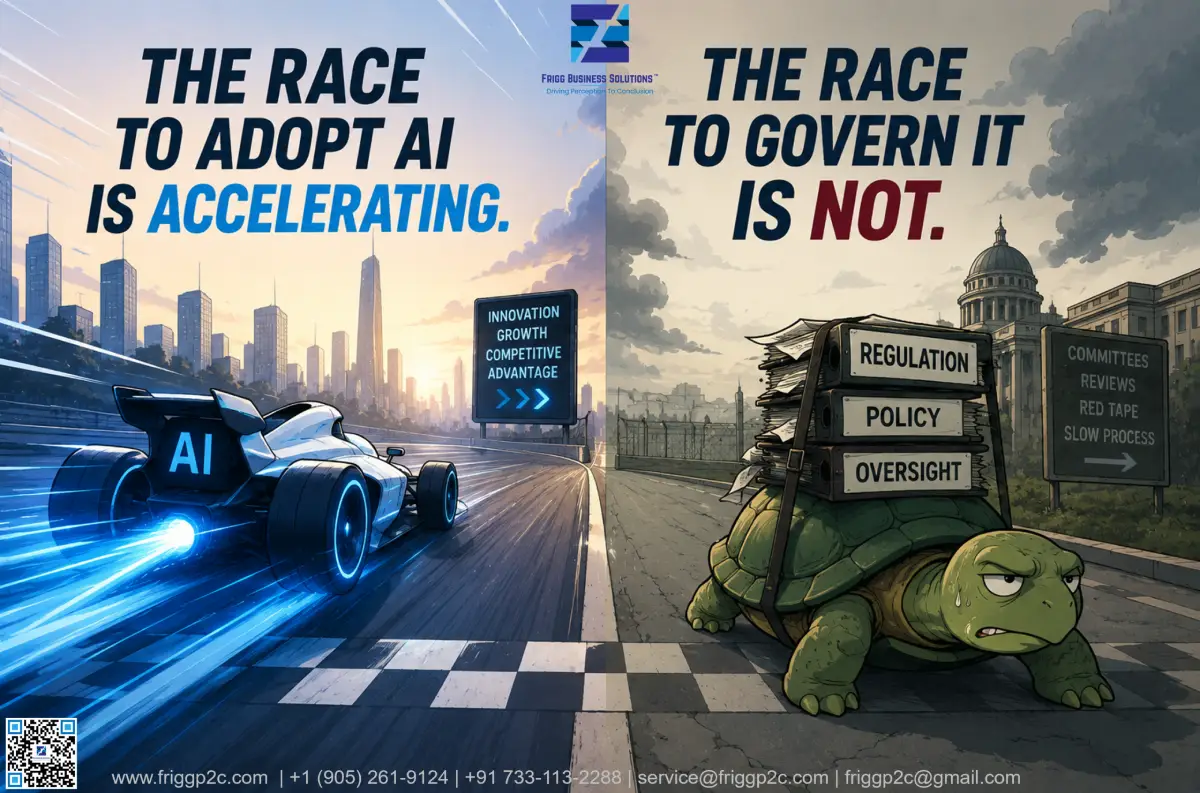
The race to adopt AI is accelerating. The race to govern it is not.
Every Organization Wants AI. Few Are Ready for Its Risks.
Artificial Intelligence is no longer a futuristic concept reserved for innovation teams and technology giants. Organizations across industries are embedding AI into customer service platforms, cybersecurity operations, risk assessments, fraud detection programs, human resource processes, financial analysis, and executive decision-making.
The promise is compelling: faster decisions, greater efficiency, reduced operational costs, and improved customer experiences.
However, as organizations rush to implement AI solutions, many are overlooking a critical question: who is accountable when AI makes a mistake?
The excitement surrounding AI adoption has created a dangerous gap between innovation and governance. While investment in AI continues to rise, governance frameworks are often struggling to keep pace. This imbalance is creating a new category of business risk that boards and executives can no longer afford to ignore.
The Shift from Innovation Risk to Governance Risk
Traditionally, organizations have focused on the technical performance of systems. If an application functioned correctly, it was considered successful. AI introduces a fundamentally different challenge.
Unlike traditional software, AI systems can learn, adapt, and generate recommendations that directly influence business outcomes. These outcomes can affect customers, employees, suppliers, regulators, shareholders, and society as a whole.
As organizations become increasingly dependent on automated decision-making, transparency becomes increasingly important.
The challenge is not simply whether AI works. The challenge is whether organizations can explain how it works, monitor its outputs, identify unintended consequences, and demonstrate accountability when something goes wrong.
This is precisely why regulators, standards bodies, and industry leaders across the world are placing greater emphasis on responsible AI governance.
Global Regulatory Expectations Are Rapidly Evolving
Governments and regulatory authorities worldwide are accelerating efforts to establish frameworks for the safe and responsible use of Artificial Intelligence.
The introduction of regulations such as the European Union AI Act, along with guidance from organizations including the OECD, NIST, ISO, and various national regulators, signals a growing expectation that organizations must govern AI systems with the same rigor applied to other critical business risks.
While the specific requirements may differ by jurisdiction, common themes continue to emerge: transparency, accountability, human oversight, risk management, privacy protection, and ethical use of AI.
The message from regulators and stakeholders is becoming increasingly clear: adopting AI is encouraged, but adopting AI without governance is not.
Why Governance Must Come Before Automation
One of the most common misconceptions surrounding AI is that governance can be added later. In reality, governance must be embedded from the beginning.
Organizations that implement AI without clear accountability structures may find themselves facing unexpected consequences. Biased outcomes, inaccurate recommendations, privacy concerns, intellectual property issues, cybersecurity vulnerabilities, and regulatory scrutiny can emerge long after a system has been deployed.
The reputational impact can be equally damaging. Customers, employees, investors, and business partners are becoming increasingly aware of how AI influences decisions. Trust can be lost quickly when organizations cannot explain or justify those decisions.
Effective governance creates confidence. It enables organizations to innovate responsibly while maintaining transparency, fairness, security, and compliance.
The Emerging Role of GRC Teams
Artificial Intelligence is no longer solely an IT issue. It has become a governance issue.
Risk managers, compliance professionals, internal auditors, legal teams, privacy officers, cybersecurity leaders, and executive leadership all have a role to play in ensuring AI systems operate within acceptable risk boundaries.
The growing convergence of these responsibilities is transforming AI governance into one of the most significant Governance, Risk, and Compliance challenges facing organizations globally.
Organizations that establish dedicated governance structures, conduct AI risk assessments, implement clear policies, and maintain ongoing oversight will be better positioned to navigate future regulatory expectations while preserving stakeholder trust.
As AI adoption expands, GRC teams will increasingly serve as the bridge between innovation and accountability.
Looking Ahead
The organizations that will benefit most from AI will not necessarily be those that deploy it fastest.
They will be the organizations that deploy it most responsibly.
As AI becomes increasingly integrated into business operations, governance will become the differentiator between sustainable innovation and avoidable risk.
The future belongs to organizations that can balance technological advancement with accountability, transparency, and trust.
The question for leaders is no longer whether AI should be adopted.
The question is whether their organization is prepared to govern it effectively.
About Frigg Business Solutions
At Frigg Business Solutions, we help organizations establish practical governance, risk management, compliance, cybersecurity, privacy, and AI governance frameworks that support innovation while maintaining regulatory compliance and stakeholder trust.
Whether your organization is beginning its AI journey or scaling enterprise-wide AI adoption, effective governance should evolve at the same pace as technology.
Website: www.friggp2c.com
Email: service@friggp2c.com
Read our other Blogs:
https://www.friggp2c.com/blog/ai-governance-canada-aida-readiness-guide
https://www.friggp2c.com/blog/vrm-explained-series-inherent-vs-residual-vendor-risk
https://www.friggp2c.com/blog/get-up-to-speed-on-ai-certification
References
- European Union AI Act
https://artificialintelligenceact.eu - National Institute of Standards and Technology (NIST) – AI Risk Management Framework
https://www.nist.gov/itl/ai-risk-management-framework - OECD Principles on Artificial Intelligence
https://oecd.ai/en/ai-principles - ISO/IEC 42001 – Artificial Intelligence Management System Standard
https://www.iso.org/standard/81230.html - World Economic Forum – Responsible AI Governance Resources
https://www.weforum.org/topics/artificial-intelligence
Start small, stay practical, and build governance as your AI maturity grows.
About the Authors
Amit Sarkar
Amit Sarkar (amit.sarkar@friggenix.ae) is the Founder of Frigg Business Solutions and now Friggenix Business Solution – FZCO in Dubai, UAE, in the USA, Canada, and India. He advises boards and regulators on AI governance, privacy compliance, cybercrime compliance, and executive liability under UAE and global regulations. A seasoned writer whose multiple articles have been published in HCCA and SCCE. He is a former CEO of a US Healthcare Regulatory Compliance service organization, and a senior global leader in GRC, IT Security, Privacy Compliance, Risk Management, HIPAA Compliance, SOC 2 Type II, and a Global Lead Auditor in multiple ISO standards.
LinkedIn: Amit Sarkar | LinkedIn