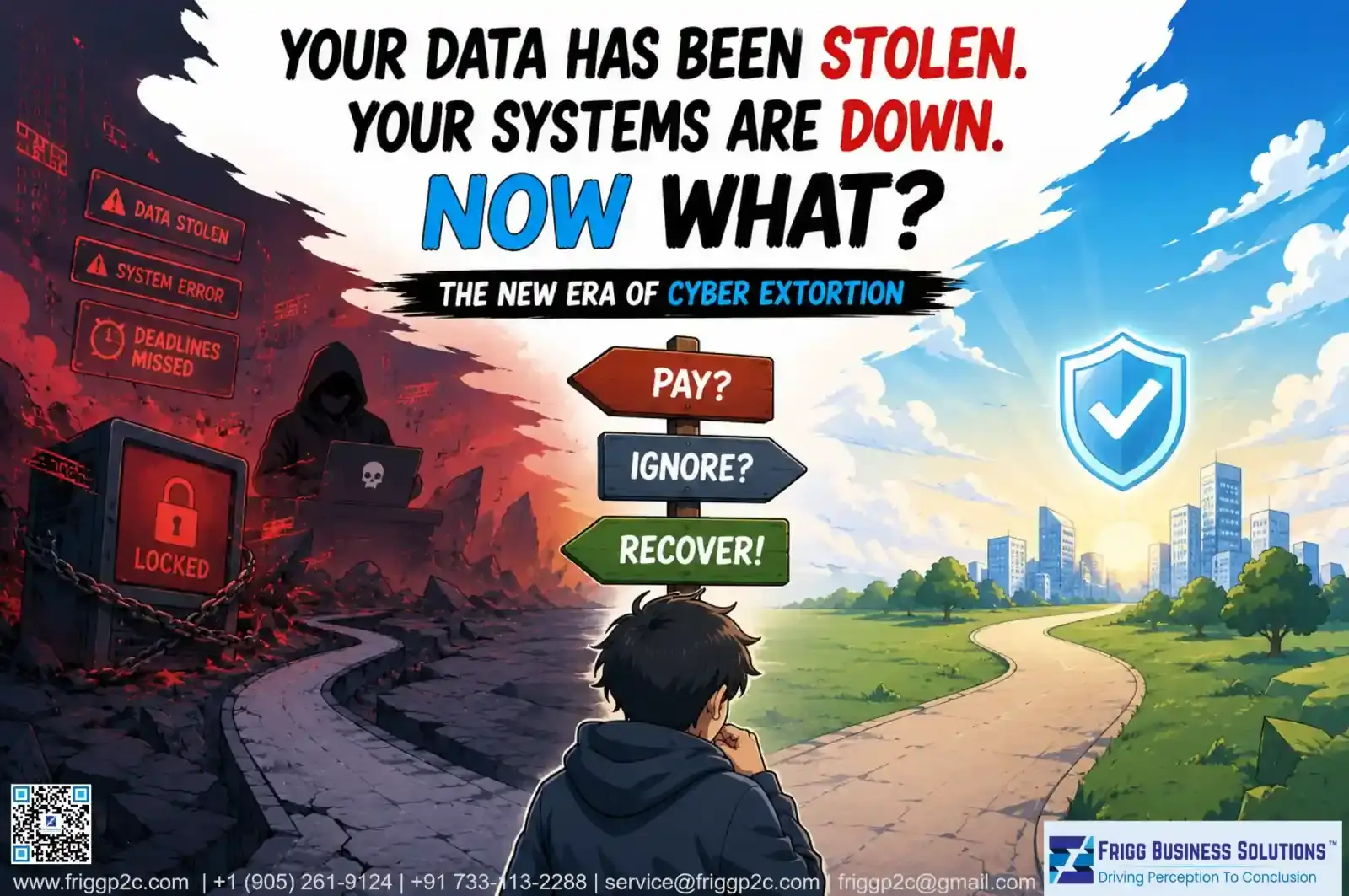
Your Data Has Been Stolen. Your Systems Are Down. Now What? The New Era of Cyber Extortion
A decade ago, ransomware attackers simply locked files and demanded payment.
Today, attackers have become far more sophisticated.
They steal sensitive information, threaten public disclosure, contact customers directly, pressure executives through media exposure, and leverage regulatory obligations to increase their chances of receiving payment.
Welcome to the era of cyber extortion.
Why Cyber Extortion Is Different
Traditional ransomware focused on availability.
Modern cyber extortion targets:
- Confidentiality
- Integrity
- Availability
- Reputation
- Regulatory exposure
Attackers understand that organizations fear public disclosure and loss of trust as much as operational downtime.
Canadian Organizations Have Already Seen the Impact
The cyber incidents involving LifeLabs, Indigo, Sobeys, healthcare providers, and public-sector organizations illustrate how attackers are increasingly targeting organizations that hold large volumes of sensitive information.
Whether the target is customer records, employee information, healthcare data, or business-critical systems, the objective remains the same: maximize pressure and maximize payment.
The Domino Effect of a Cyber Extortion Attack
Stage 1: Initial Compromise
Attackers gain access through:
- Phishing emails
- Stolen credentials
- Vulnerable systems
- Third-party vendors
Stage 2: Data Exfiltration
Sensitive information is copied and removed from the network.
Stage 3: Operational Disruption
Systems become unavailable, affecting:
- Customer services
- Supply chains
- Internal operations
Stage 4: Public Pressure
Threat actors threaten to:
- Leak information
- Notify customers
- Publicize the attack
- Damage brand reputation
Stage 5: Regulatory Scrutiny
Organizations may face:
- Privacy investigations
- Mandatory notifications
- Compliance reviews
- Legal proceedings
Why Healthcare and Public Sector Organizations Remain Prime Targets
Healthcare and public-sector entities often possess:
- High-value personal information
- Legacy systems
- Large user populations
- Critical operational requirements
Attackers know these organizations face immense pressure to restore services quickly, making them attractive targets for extortion campaigns.
The Boardroom Conversation Has Changed
Boards are no longer asking:
“How many firewalls do we have?”
They are asking:
- How quickly can we recover?
- What data could be exposed?
- What is our regulatory exposure?
- How will customers react?
- How prepared are we for a public crisis?
These are business questions—not technology questions.
The Future of Cyber Resilience
Organizations that succeed against cyber extortion will not be those that prevent every attack.
They will be the organizations that:
- Detect incidents early
- Respond effectively
- Recover rapidly
- Communicate transparently
- Protect stakeholder trust
In today’s threat landscape, resilience is the ultimate competitive advantage.
The organizations that prepare today will be the organizations that continue operating tomorrow.
Disclaimer: The incidents referenced in this article are based on publicly reported information, regulatory findings, and official organizational statements available at the time of writing. The purpose of these examples is educational and informational, highlighting cybersecurity, privacy, and business resilience lessons for organizations.
Sources & References:
LifeLabs Cyber Extortion Case
- Ontario Information and Privacy Commissioner – LifeLabs Investigation Findings
Ontario IPC Report (ipc.on.ca) - Ontario IPC Backgrounder on LifeLabs Privacy Breach
LifeLabs Breach Backgrounder (ipc.on.ca) - Joint Investigation Report – Office of the Information and Privacy Commissioner for British Columbia
BC OIPC Investigation Report (OIPC British Columbia)
Indigo Books & Music Cyber Extortion Incident
- CityNews – Indigo Cyberattack Timeline
CityNews Indigo Timeline (CityNews Toronto) - Global News – Indigo Employee Data Compromised in Ransomware Attack
Global News Report (Global News) - Newswire – Indigo Operational Disruption and Financial Impact
Indigo Corporate Statement (Newswire)
Sobeys / Empire Company Business Disruption Example
- SecurityWeek – Sobeys Ransomware Incident
SecurityWeek Sobeys Report (SecurityWeek) - QuickIntel – Business Impact Analysis of Sobeys Incident
QuickIntel Analysis (Quick Intelligence)
Regulatory and Privacy Investigation Examples
- Ontario & British Columbia Privacy Commissioners Statement on LifeLabs Privacy Breach
Privacy Commissioners Statement (Newswire) - Ontario Court and Privacy Commissioner Proceedings Related to LifeLabs
Canadian Lawyer Analysis (Canadian Lawyer)
Preparation, resilience, and rapid response are the strongest defenses against modern cyber extortion.
Cyber Extortion in Canada: Building Resilience Before the Attack Happens
Connect with Frigg’s experts today for tailored guidance, proactive strategies, and compliant frameworks that strengthen security, ensure resilience, and accelerate confident growth outcomes.
Get in touch with us at: service@friggp2c.com, info@friggenix.ae, amit.sarkar@friggp2c.com, or Call us at: +1 (905) 261-9124 | +1 (905) 261-9123 | +1 (866) 907-7227 | +91 733-113-2288 | +971 58 137 9867
Build resilience today to protect your data, operations, and reputation tomorrow.
About the Authors
Harini Pallavi
Harini is one of the principal auditors for Frigg Business Solutions. She is an accomplished information security expert who led critical security initiatives that shielded multinational corporations from cyber-attacks, thwarted data breaches, and secured critical infrastructure.
Harini has successfully implemented the Health Information Trust Alliance – (HITRUST) common security framework and ensured 100% compliance in all these organizations. She is a Certified Risk Professional (CRiSP), Information Security Lead Auditor, HITRUST Implementor, HIPAA Compliance Expert, and Certified in Six Sigma (Black belt & Green belt).