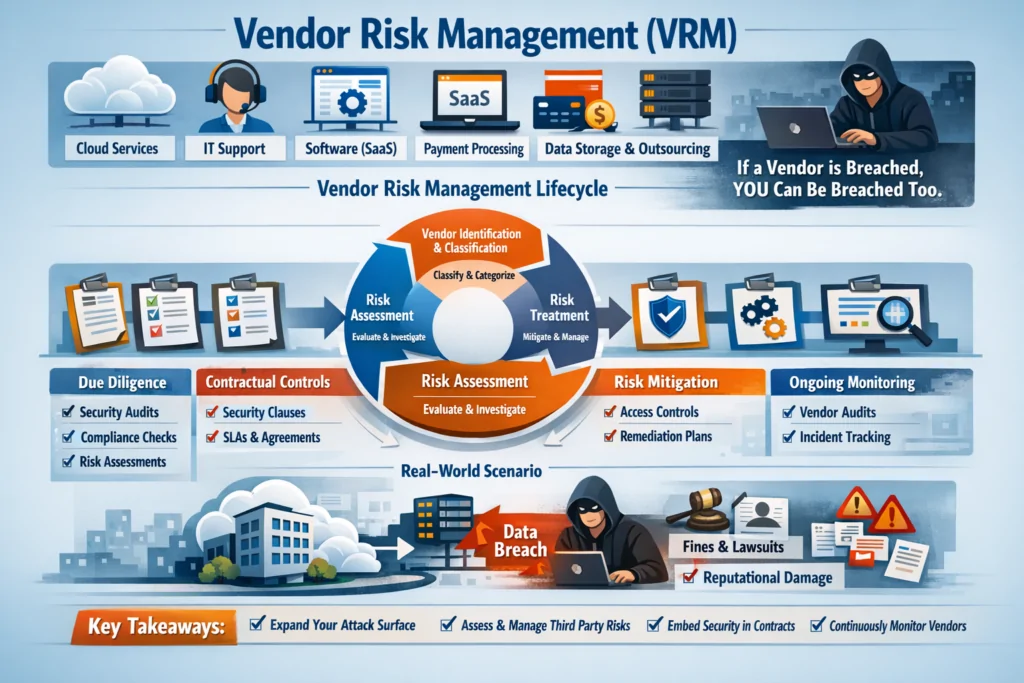
Introduction to Vendor Risk Management (VRM)
Vendor Risk Management (VRM), also known as Third-Party Risk Management (TPRM), is the process by which an organization identifies, assesses, manages, and monitors risks arising from its relationships with external vendors, suppliers, and service providers, particularly cybersecurity risks.
In today’s environment, organizations rely heavily on vendors for:
- Cloud services
- IT support
- Software (SaaS)
- Payment processing
- Data storage
- Outsourcing
Vendor Risk Management Lifecycle
Vendor Identification & Classification
- Identify all third parties.
- Data sensitivity
- System access
- Business criticality
Risk Assessment (Due Diligence)
Before onboarding, assess:
- Information security controls
- Data protection practices
- Incident response capability
- Past breaches
- Compliance posture
- Security questionnaires
- Document reviews
- Certifications (ISO, SOC reports)
Risk Treatment & Mitigation
Based on risk level:
- Require security improvements.
- Limit data access.
- Add contractual controls.
- Reject high-risk vendors.
Contractual & Legal Controls
Security requirements are embedded into:
- Contracts
- SLAs
- Data processing agreements
- Encryption requirements
- Breach notification timelines
- Right-to-audit clauses
Continuous Monitoring
Risk does not stop after onboarding:
- Periodic reassessments
- Monitoring security posture
- Tracking incidents & changes
- Re-evaluating access levels
Real-World Example (Cyber Context)
Scenario:
A company uses a cloud-based HR system.
Vendor stores employee personal data. A breach exposes employee records. Companies face regulatory fines, Lawsuits, and Reputational damage.
Root cause: Inadequate vendor security assessment.
Who Owns Vendor Risk Management?
- Cybersecurity / InfoSec
- GRC / Risk Management
- Legal & Compliance
- Procurement
- Business owners
Key Takeaways
- Vendors expand your attack surface.
- VRM is essential to modern cybersecurity.
- Third-party risk must be identified, assessed, and monitored.
- Strong VRM reduces breaches, fines, and downtime.
- VRM is a strategic GRC capability, not a checkbox.
Need help understanding the Legal Penalties, Criminal Liability, Board-Level Accountability, and Corporate Exposure?
We at Friggenix Business Solution – FZCO offer specialized services to clarify your position, conduct a precise compliance gap analysis, and build a cyber framework that meets your specific UAE regulatory needs.
Contact us today to ensure your business is not only secure but also demonstrably compliant. Schedule a confidential assessment to discuss practical, risk-aligned mitigation strategies tailored to your industry and regulatory environment.
Contact our experts at: info@friggenix.ae | +971 54 489 2599 | +971 58 137 9867 | +91 733-113-2288 | www.friggenix.ae
Let’s secure what’s exposed—before it’s exploited.
About the Authors
Amit Sarkar (amit.sarkar@friggp2c.com) is the Founder of Frigg Business Solutions, registered in the USA, Canada, and India, and now Friggenix Business Solution – FZCO in Dubai, UAE. A seasoned writer whose multiple articles have been published in HCCA and SCCE. He is a former CEO of a US Healthcare Regulatory Compliance service organization, and a senior global leader in GRC, IT Security, Privacy Compliance, Risk Management, HIPAA Compliance, SOC 2 Type II, and a Global Lead Auditor in multiple ISO standards.
LinkedIn: Amit Sarkar | LinkedIn