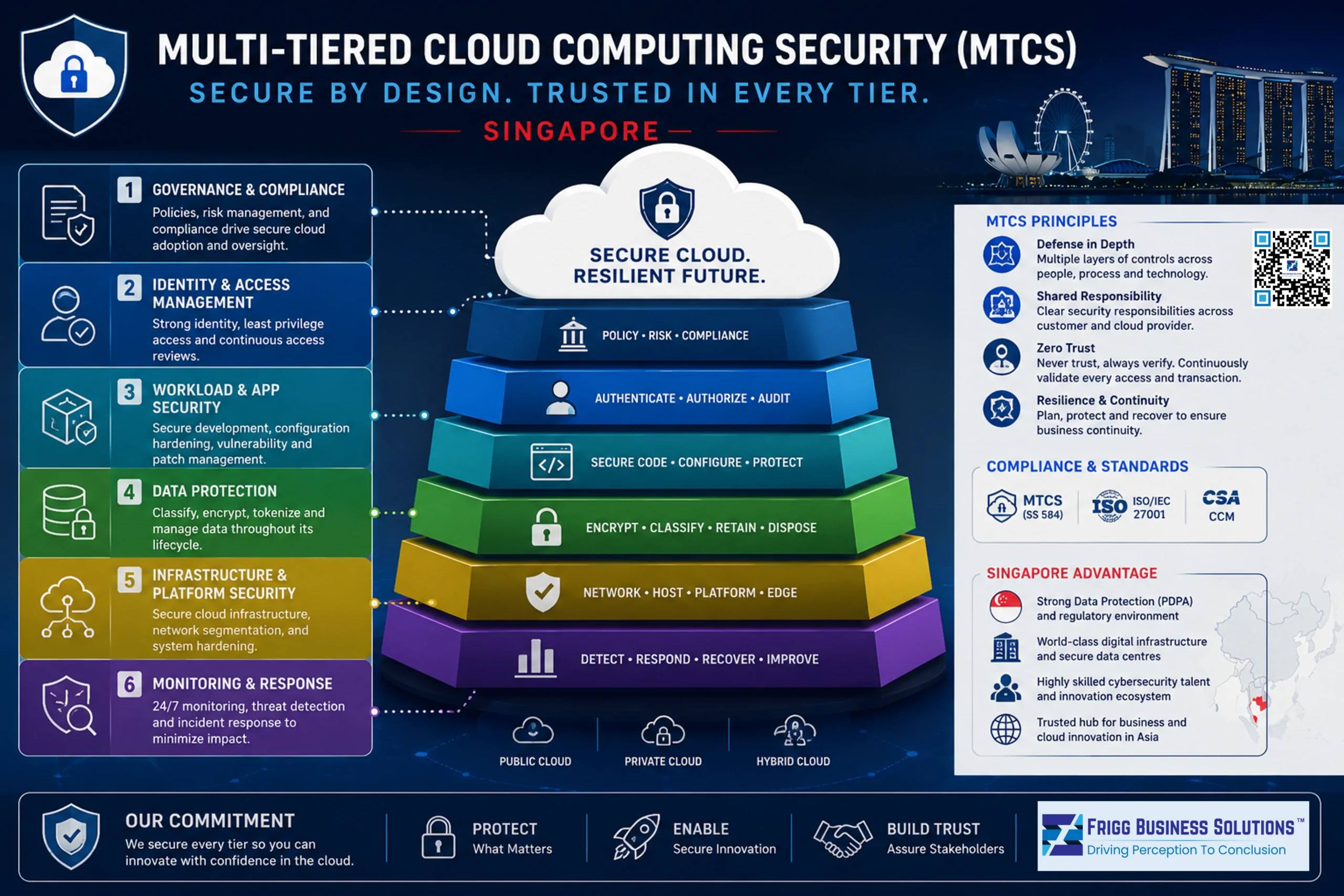
A Detailed Guide to Singapore’s Cloud Security Certification Framework
As cloud adoption accelerates globally, governments and regulators are increasingly demanding stronger security assurance from Cloud Service Providers (CSPs). Singapore was one of the first countries to formalize cloud security requirements through the Multi-Tier Cloud Security (MTCS) standard, officially known as Singapore Standard SS 584.
Developed by Singapore, MTCS helps organizations assess whether a cloud provider has the right level of security controls based on the sensitivity and criticality of the data being hosted.
MTCS has become a major trust benchmark for cloud providers operating in Singapore and is increasingly relevant for sectors such as banking, healthcare, government, telecommunications, and critical infrastructure. (Infocomm Media Development Authority)
What is Multi-Tiered Cloud Computing Security (MTCS)?
Infocomm Media Development Authority (IMDA) defines MTCS (SS 584) as a cloud security certification framework that establishes tiered levels of security controls for cloud environments.
Unlike generic security standards, MTCS recognizes that not all cloud workloads carry the same level of risk. A marketing website and a national healthcare platform should not require identical security controls.
MTCS therefore applies three graduated security tiers, allowing organizations to choose cloud services aligned with business risk and regulatory expectations. (Infocomm Media Development Authority)
The current standard is:
SS 584:2020 – Specification for Multi-tiered Cloud Computing Security (MTCS). (Infocomm Media Development Authority)
Why Was MTCS Created?
Traditional standards like:
- International Organization for Standardization ISO 27001
- ISO 27017 (Cloud Security)
- ISO 27018 (Privacy in Cloud)
- CSA STAR
Provide strong information security guidance but may not sufficiently address cloud-specific risks, including:
- Multi-tenancy risks
- Shared responsibility challenges
- Hypervisor and virtualization security
- Data segregation concerns
- Tenant isolation
- Cloud resilience and service continuity
- Cross-border data protection
Singapore introduced MTCS to close these cloud-specific gaps and provide clear assurance levels for organizations evaluating cloud providers. It was launched in 2013 and later revised, with SS 584:2020 being the latest version. (Infocomm Media Development Authority)
The 3 MTCS Security Tiers Explained
Tier 1 – Basic Security Requirements
Tier 1 is intended for:
- Non-business critical systems
- Public websites
- Development/test environments
- Low-risk workloads
This level focuses on:
- Basic cybersecurity hygiene
- Foundational security controls
- Basic governance and risk management
Example Use Cases:
- Public information portals
- Low-sensitivity SaaS applications
- Internal productivity tools
This is the minimum security baseline for cloud services. (Infocomm Media Development Authority)
Tier 2 – Enhanced Security Requirements
Tier 2 is designed for:
- Business-critical systems
- Moderate-risk environments
- Sensitive enterprise workloads
This level includes:
- Stronger governance controls
- Improved tenant isolation
- Enhanced access management
- Security monitoring and incident handling
- Stronger compliance expectations
Example Use Cases:
- Enterprise HR systems
- CRM platforms
- Financial business applications
Organizations with moderate regulatory obligations often choose Tier 2 certified providers. (Microsoft Learn)
Tier 3 – High Assurance Security Requirements
Tier 3 is the highest and most stringent level.
It is intended for:
- Highly regulated sectors
- Government workloads
- Critical information infrastructure
- Sensitive healthcare and financial data
Tier 3 includes:
- Advanced resiliency controls
- Stronger operational security
- Enhanced data protection
- High availability requirements
- More rigorous monitoring and auditing
Example Use Cases:
- National healthcare systems
- Banking infrastructure
- Government digital platforms
- Critical infrastructure systems
Tier 3 often aligns with organizations handling high-impact information systems. (Microsoft Learn)
Key Security Domains Covered Under MTCS
MTCS evaluates cloud security across multiple domains.
- Governance & Risk Management
Organizations must demonstrate:
- Security governance structures
- Risk assessment methodologies
- Management accountability
- Policy enforcement
- Identity & Access Management (IAM)
Focus areas include:
- Role-based access control (RBAC)
- Privileged account management
- MFA implementation
- Access reviews
- Infrastructure & Virtualization Security
Because cloud is multi-tenant by design, MTCS emphasizes:
- Virtual machine isolation
- Hypervisor security
- Segregation between tenants
- Secure cloud architecture
- Data Protection & Privacy
Organizations must address:
- Encryption at rest and in transit
- Backup management
- Data retention
- Secure deletion
- Data leakage prevention
- Security Monitoring & Incident Response
Controls include:
- Logging and monitoring
- Threat detection
- Incident response readiness
- Security event management
- Business Continuity & Resilience
Key expectations:
- Disaster recovery plans
- Backup strategies
- Recovery testing
- Service continuity
- Compliance & Auditability
Cloud providers must show:
- Third-party assessments
- Independent audits
- Evidence of control effectiveness
MTCS certification itself requires independent assessment through accredited certification bodies. (sac-accreditation.gov.sg)
How MTCS Differs from ISO 27001
| Area | MTCS | ISO 27001 |
| Focus | Cloud-specific security | General information security |
| Structure | Tier-based assurance | Risk-based ISMS |
| Cloud Risks | Strong focus | Limited direct cloud emphasis |
| Multi-tenancy | Explicitly addressed | Not primary focus |
| CSP Suitability | Built for cloud providers | Broad applicability |
A practical way to think about it:
ISO 27001 tells you how to secure information.
MTCS tells you how to secure cloud environments specifically.
Many Tier 3 providers maintain both ISO 27001 and MTCS certification. (Amazon Web Services, Inc.)
Why MTCS Matters for Businesses
- Better Vendor Assurance
MTCS helps organizations quickly assess whether a cloud provider’s controls are suitable for their risk profile.
- Regulatory Confidence
For regulated sectors, MTCS provides stronger confidence during audits and due diligence.
- Reduced Third-Party Risk
It reduces uncertainty around:
- Data exposure risks
- Misconfiguration risks
- Poor tenant segregation
- Government and Enterprise Trust
Certain Singapore public-sector and regulated procurement environments strongly prefer or require MTCS-certified providers. (Socotec Certification Singapour)
Major Cloud Providers Supporting MTCS
Several hyperscalers and major providers maintain MTCS certifications, including:
Many enterprise buyers now review MTCS certifications as part of cloud vendor risk assessments. (Google Cloud)
Key Areas Organizations Should Focus On
If your organization is adopting cloud or assessing cloud providers, prioritize these areas:
- Identify Data Criticality
Classify workloads into:
- Low sensitivity
- Business critical
- Highly regulated
Then align them to the right MTCS tier.
- Validate Vendor Certifications
Ask cloud providers for:
- MTCS certificate
- Scope of certification
- Tier achieved
- Audit reports
- Strengthen Shared Responsibility
Clarify:
- What the CSP secures
- What your organization secures
- Focus on IAM & Privileged Access
Most cloud breaches happen due to:
- Weak access controls
- Excessive permissions
- Credential compromise
- Review Data Residency & Privacy
Especially for:
- Healthcare
- BFSI
- Government
- Privacy-sensitive industries
- Build Continuous Compliance Monitoring
Certification alone is not enough.
Continuously monitor:
- Misconfigurations
- Identity risks
- Security drift
Top Key Takeaways
- MTCS is Singapore’s cloud security standard
It provides a structured way to assess cloud provider security.
- It uses a tiered approach
Organizations can select security assurance based on risk.
- Tier 3 is the highest level
Ideal for highly regulated and critical systems.
- MTCS complements ISO 27001
It strengthens cloud-specific security expectations.
- Vendor due diligence becomes easier
Organizations can quickly assess cloud maturity.
- It is increasingly important for regulated sectors
Healthcare, finance, telecom, and government benefit the most.
Immediate Next Steps for Organizations
Immediate (0–30 Days)
- Inventory cloud workloads
- Classify business criticality
- Identify current cloud providers
- Verify MTCS certification status
Short-Term (30–90 Days)
- Perform a cloud risk assessment
- Review IAM and privileged access controls
- Assess CSPM (Cloud Security Posture Management) maturity
- Update third-party risk questionnaires
Medium-Term (90–180 Days)
- Align cloud governance with MTCS controls
- Improve monitoring and logging
- Implement resilience and DR testing
- Establish cloud compliance dashboards
Final Thought
MTCS is more than a certification — it is a cloud trust framework. Organizations moving toward regulated cloud adoption should treat MTCS as a practical benchmark for cloud assurance, vendor selection, and cyber resilience.
For organizations operating across regions such as Singapore, UAE, India, or North America, understanding frameworks like MTCS also strengthens global compliance readiness and multi-cloud governance maturity.
Government Reference Links
Official Singapore Government Sources
IMDA – Cloud Computing & MTCS
IMDA Cloud Computing & Services Page
IMDA – Compliance & Certification
IMDA MTCS Compliance & Certification Page
Singapore Accreditation Council (SAC) – MTCS Accreditation
SAC MTCS Accreditation Programme
Cyber Security Agency of Singapore (CSA)
CSA Singapore Official Website
Preparation, resilience, and rapid response are the strongest defenses against modern cyber extortion.
Connect with Frigg’s experts today for tailored guidance, proactive strategies, and compliant frameworks that strengthen security, ensure resilience, and accelerate confident growth outcomes.
Get in touch with us at: service@friggp2c.com, info@friggenix.ae, amit.sarkar@friggp2c.com, or Call us at: +1 (905) 261-9124 | +1 (905) 261-9123 | +1 (866) 907-7227 | +91 733-113-2288 | +971 58 137 9867
Build resilience today to protect your data, operations, and reputation tomorrow.
About the Authors
Harini Pallavi
Harini is one of the principal auditors for Frigg Business Solutions. She is an accomplished information security expert who led critical security initiatives that shielded multinational corporations from cyber-attacks, thwarted data breaches, and secured critical infrastructure.
Harini has successfully implemented the Health Information Trust Alliance – (HITRUST) common security framework and ensured 100% compliance in all these organizations. She is a Certified Risk Professional (CRiSP), Information Security Lead Auditor, HITRUST Implementor, HIPAA Compliance Expert, and Certified in Six Sigma (Black belt & Green belt).