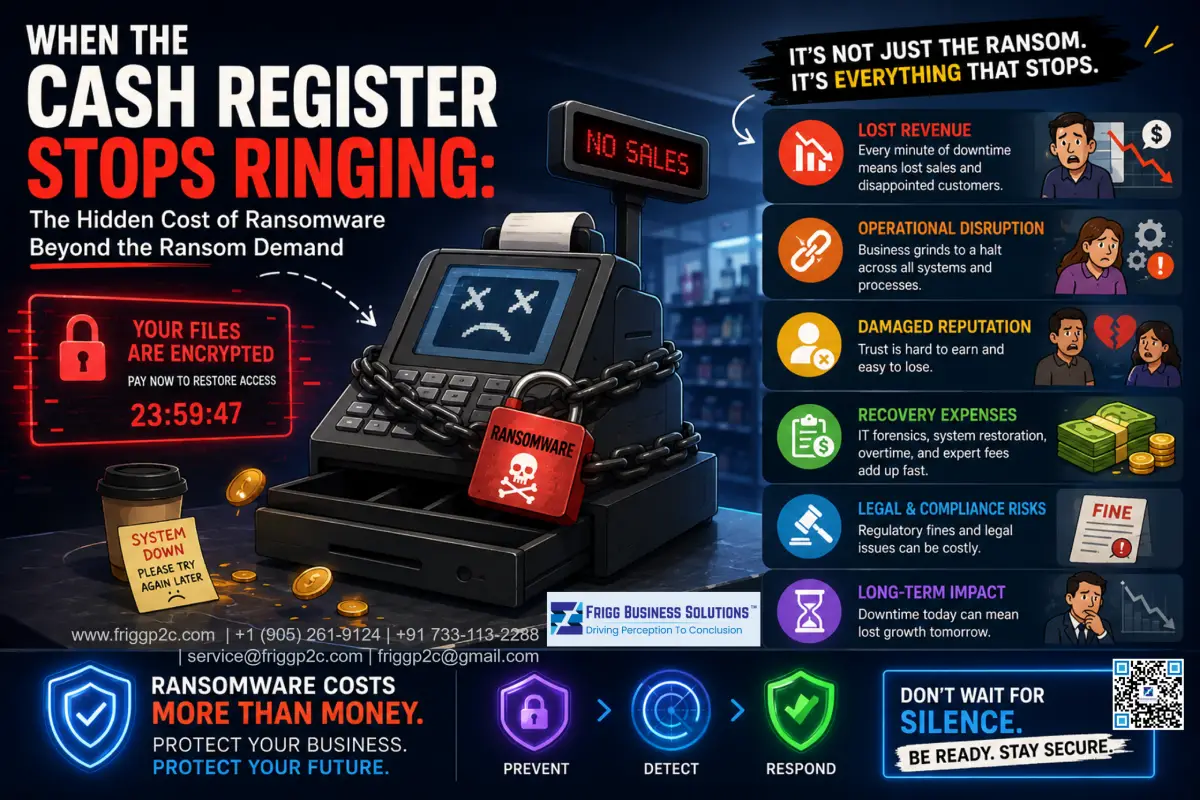
When the Cash Register Stops Ringing: The Hidden Cost of Ransomware Beyond the Ransom Demand
For many organizations, ransomware is often viewed as an IT problem—a technical incident that can be resolved by restoring systems and applying patches.
Reality tells a very different story.
Modern ransomware attacks are designed not only to encrypt systems but also to disrupt operations, steal sensitive data, pressure executives, attract media attention, and damage customer trust. The ultimate goal is business extortion.
Canada has witnessed several high-profile incidents that demonstrate how cyberattacks can quickly become enterprise-wide crises.
The Sobeys Lesson: Business Disruption at Scale
When Empire Company, the parent organization of Sobeys, experienced a cyberattack, the consequences extended far beyond technology systems.
Customers experienced disruptions to pharmacy services, gift cards, loyalty programs, and self-checkout functions. What began as a cybersecurity incident rapidly evolved into an operational challenge affecting employees, customers, suppliers, and healthcare services.
The incident highlighted an important reality: ransomware can interrupt critical services that millions of people rely upon every day.
Indigo: When Data Becomes the Target
The Indigo cyber incident demonstrated another dangerous evolution of ransomware attacks.
Beyond operational disruptions, personal information belonging to current and former employees was reportedly exposed. The attack triggered extensive investigations, recovery efforts, and public scrutiny.
Organizations today must recognize that attackers increasingly view data as a bargaining chip. Even if systems are restored, stolen information may continue to create regulatory, legal, and reputational challenges for years.
LifeLabs: The Cost of Losing Trust
The LifeLabs breach remains one of Canada’s most significant cybersecurity events.
As a healthcare organization handling sensitive patient information, the incident resulted in substantial public concern, regulatory attention, legal action, and settlement costs.
The lesson was clear: trust is often more difficult and expensive to rebuild than technology systems.
The Four Business Impacts Every Executive Should Understand
1. Operational Shutdowns
Organizations may experience:
- Service interruptions
- Supply chain delays
- Reduced productivity
- Customer service failures
2. Regulatory Investigations
Privacy regulators increasingly expect organizations to:
- Demonstrate due diligence
- Maintain appropriate safeguards
- Report breaches promptly
- Show evidence of effective governance
3. Data Breaches
Modern ransomware groups frequently steal information before encryption, creating additional risks related to:
- Privacy violations
- Legal liabilities
- Customer notifications
- Class-action lawsuits
4. Reputational Damage
Customers may forgive downtime.
They rarely forget compromised trust.
Negative publicity can impact customer retention, investor confidence, partner relationships, and future business opportunities long after systems are restored.
Building Resilience Before the Next Attack
Organizations should focus on:
- Zero Trust security models
- Multi-factor authentication
- Employee security awareness
- Incident response planning
- Regular backup testing
- Third-party risk management
- Cybersecurity governance at the board level
The question is no longer whether ransomware will continue to target organizations.
The real question is whether organizations are prepared for the business consequences when it happens.
Cybersecurity is no longer solely an IT function—it is a business resilience strategy.
References:
Sobeys / Empire Company Cyber Incident
- SecurityWeek – Canadian Supermarket Chain Sobeys Hit by Ransomware Attack
SecurityWeek Article (SecurityWeek) - QuickIntel – The Impact of Ransomware on Retailers: Chaos at Sobeys
QuickIntel Analysis (Quick Intelligence)
Indigo Books & Music Cyberattack
- CityNews – Timeline of Indigo’s Leadership Changes and Cyberattack
CityNews Timeline (CityNews Toronto) - Newswire – Indigo FY23 Results and Ransomware Attack Update
Indigo Corporate Update (Newswire) - Canadian Underwriter – Indigo Refuses to Pay Ransom
Canadian Underwriter Report (Canadian Underwriter)
LifeLabs Privacy Breach
- Ontario Information and Privacy Commissioner – Investigation Report on LifeLabs Privacy Breach Affecting Millions of Canadians
Ontario IPC Investigation Report (ipc.on.ca) - Saskatchewan Information and Privacy Commissioner – Statement on LifeLabs Privacy Breach
Saskatchewan IPC Statement (Saskatchewan IPC)
Key Findings Referenced
The examples cited demonstrate how ransomware and cyber extortion can result in:
- Operational shutdowns
- Service disruptions
- Data theft and privacy breaches
- Regulatory investigations
- Financial losses
- Long-term reputational damage
Supported by the incidents involving Sobeys, Indigo, and LifeLabs. (SecurityWeek)
Disclaimer: The incidents referenced in this article are based on publicly reported information, regulatory findings, and official organizational statements available at the time of writing. The purpose of these examples is educational and informational, highlighting cybersecurity, privacy, and business resilience lessons for organizations.
Preparation, resilience, and rapid response are the strongest defenses against modern cyber extortion.
Cyber Extortion in Canada: Building Resilience Before the Attack Happens
Connect with Frigg’s experts today for tailored guidance, proactive strategies, and compliant frameworks that strengthen security, ensure resilience, and accelerate confident growth outcomes.
Get in touch with us at: service@friggp2c.com, info@friggenix.ae, amit.sarkar@friggp2c.com, or Call us at: +1 (905) 261-9124 | +1 (905) 261-9123 | +1 (866) 907-7227 | +91 733-113-2288 | +971 58 137 9867
Build resilience today to protect your data, operations, and reputation tomorrow.
About the Authors
Harini Pallavi
Harini is one of the principal auditors for Frigg Business Solutions. She is an accomplished information security expert who led critical security initiatives that shielded multinational corporations from cyber-attacks, thwarted data breaches, and secured critical infrastructure.
Harini has successfully implemented the Health Information Trust Alliance – (HITRUST) common security framework and ensured 100% compliance in all these organizations. She is a Certified Risk Professional (CRiSP), Information Security Lead Auditor, HITRUST Implementor, HIPAA Compliance Expert, and Certified in Six Sigma (Black belt & Green belt).