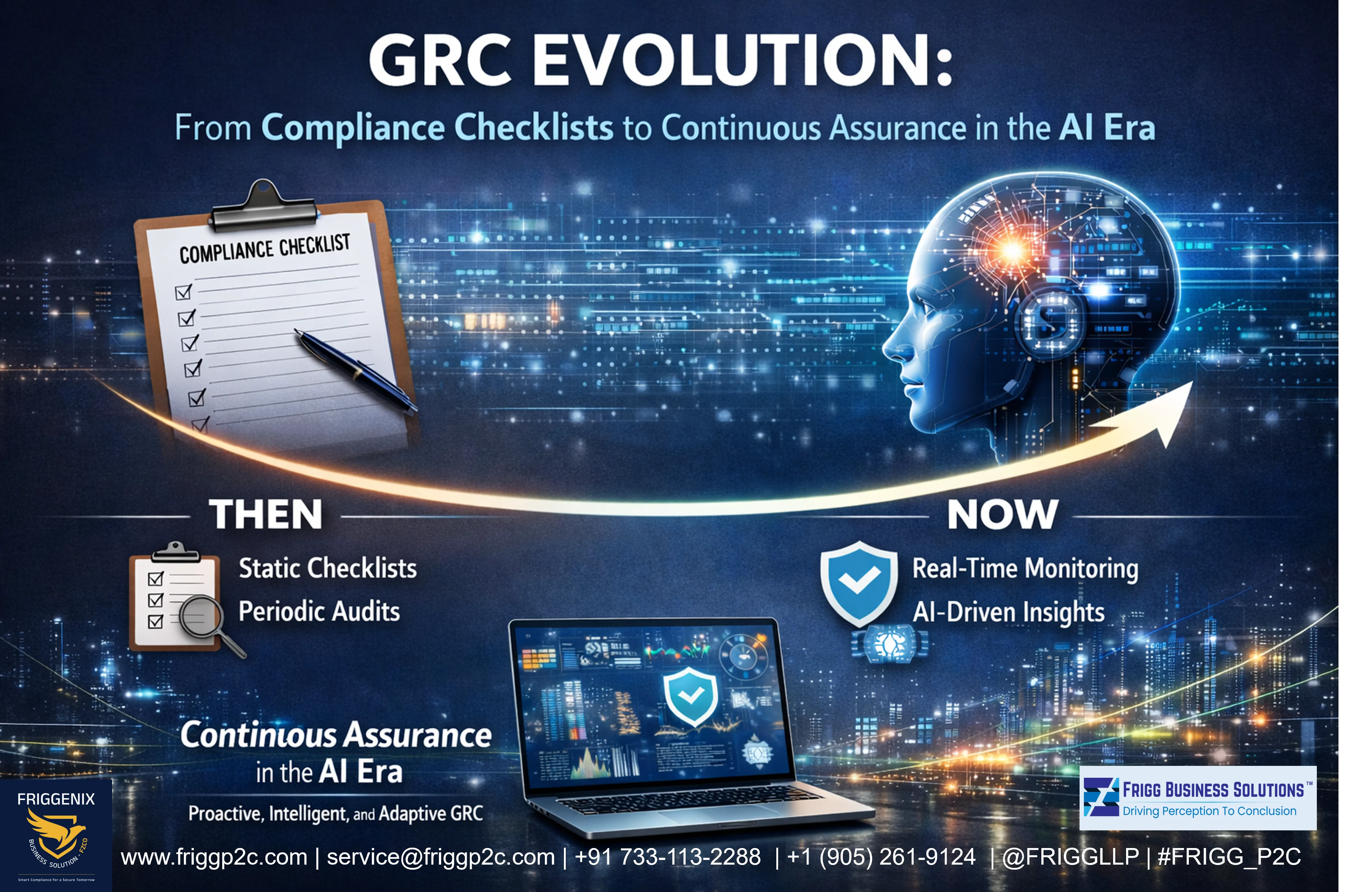
Governance, Risk & Compliance (GRC) Is No Longer What It Used to Be
For years, Governance, Risk & Compliance (GRC) operated as a checkpoint function — periodic audits, policy reviews, and compliance exercises conducted once or twice a year. Organizations prepared for audits, passed assessments, and moved on.
But today’s risk landscape has fundamentally changed.
Cyber incidents unfold in minutes. AI systems make autonomous decisions. Regulations increasingly hold leadership personally accountable. In this environment, traditional, point-in-time compliance is no longer sufficient.
GRC is undergoing a structural evolution — from documentation-driven compliance to continuous, technology-enabled assurance.
From Point-in-Time Compliance to Continuous Assurance
Annual audits were designed for slower business cycles. Modern digital ecosystems operate continuously — cloud deployments, API integrations, remote workforces, and AI-driven automation introduce risk every second.
The future of governance lies in real-time visibility.
Continuous assurance means:
- Controls monitored automatically rather than manually verified
- Risks detected as they emerge, not months later
- Governance embedded into operational workflows
Organizations are shifting from asking “Were we compliant last quarter?” to “Are we secure and compliant right now?”
This shift transforms GRC from a reactive function into a live operational capability.
Executive Accountability: Compliance Is Now Personal
Regulators worldwide are redefining accountability. Increasingly, breaches are not viewed merely as technical failures but as governance failures.
Board members and executives are facing:
- Personal liability exposure
- Regulatory scrutiny over oversight failures
- Expectations to demonstrate proactive risk governance
Leadership can no longer delegate compliance entirely to IT or legal teams. Governance effectiveness is now a boardroom responsibility, requiring measurable oversight, informed decision-making, and demonstrable risk awareness.
In short: compliance failures increasingly carry human consequences, not just organizational penalties.
Compliance as Code: Embedding Governance into Technology
One of the most transformative shifts in modern GRC is the emergence of Compliance-as-Code (CaC) or Policy-as-Code.
Instead of policies existing as static documents, organizations are translating rules into executable logic embedded within technology pipelines.
Examples include:
- Automated cloud configuration checks aligned with regulatory standards
- Security policies enforced directly in DevOps workflows
- Deployment blocks triggered when compliance thresholds are violated
Governance moves upstream — becoming part of system design rather than post-implementation verification.
When compliance becomes programmable, it becomes scalable.
GRC Meets AI: Governing Systems That Learn and Decide
Artificial Intelligence introduces a new category of risk: systems that evolve after deployment.
Traditional governance models struggle with:
- Algorithmic bias
- Model drift
- Data provenance risks
- Explainability and accountability gaps
AI governance requires organizations to rethink risk frameworks entirely:
- Continuous monitoring of AI outputs
- Ethical oversight mechanisms
- Transparent model lifecycle governance
- Cross-functional accountability between business, technology, and compliance teams
GRC must evolve from controlling processes to governing intelligent systems.
The Real Transformation: GRC as a Strategic Enabler
The organizations leading this evolution no longer treat GRC as a cost center. Instead, they see it as:
- A trust accelerator
- A resilience framework
- A competitive differentiator
Modern governance enables faster innovation because risks are managed proactively rather than discovered later.
The question is no longer whether GRC will change — it already has.
A Question for Every Leader, Risk Professional, and Technologist:
Is your organization still preparing for audits… or has it started building governance that works every single day?
Need help understanding the Legal Penalties, Criminal Liability, Board-Level Accountability, and Corporate Exposure?
We at Friggenix Business Solution and Frigg Business Solutions offer specialized services to conduct a Precise and FREE Gap Assessment and help in implementing the Privacy framework that meets the specific business and regulatory needs.
Contact us today to ensure your business is not only secure but also demonstrably compliant. Schedule a confidential assessment to discuss practical, risk-aligned mitigation strategies tailored to your industry and regulatory environment.
You can send an email to us at: info@friggenix.ae or service@friggp2c.com
Call us on: +971 58 137 9867 | +971 54 489 2599 | +91 733-113-2288 | +1 (905) 261-9123 | +1 (905) 261-9124
Smart Compliance for a Secure Tomorrow
About the Authors
Amit Sarkar
Amit Sarkar (amit.sarkar@friggenix.ae) is the Founder of Frigg Business Solutions and now Friggenix Business Solution – FZCO in Dubai, UAE, in the USA, Canada, and India. He advises boards and regulators on AI governance, privacy compliance, cybercrime compliance, and executive liability under UAE and global regulations. A seasoned writer whose multiple articles have been published in HCCA and SCCE. He is a former CEO of a US Healthcare Regulatory Compliance service organization, and a senior global leader in GRC, IT Security, Privacy Compliance, Risk Management, HIPAA Compliance, SOC 2 Type II, and a Global Lead Auditor in multiple ISO standards.